Showing posts with label athens. Show all posts

Sunday, 24 November 2013

Athens:Agioi Anargyri ( Άγιοι Ανάργυροι), Pilgrimage, and the Holy Fire


Open between 9:30 and 1:30, for evening services when held and services on Sunday. Agioi Anargyroi can be entered by a small gate at the end of Thrasyvoulou St, from Prytaneiou St, or from a door beside the Exarchate (18 Erectheos Street Tel. 210-322 5810

Agioi Anargyroi, a single-naved barrel vaulted church, was built in 1600. No doubt it replaced something older (some say an 8th century church built by the Empress Irene). Many renovations have occurred since according to the needs and uses of the church.  They say that the roof shape was influenced by Ottoman public buildings of the time. It reminds me of Pantanassa in Monastiraki. In 1972 the Ephorate of Byzantine Antiquities (well, post-Byzantine in this case – the polite way to refer to the Ottoman era) renovated the outside of the church to restore its original appearance – and very attractive it is. The overall masonry consists of small, plain stones (rubble masonry) accented at the corners by marble or stone blocks, spolia, or debris from earlier structures. The wall paintings are modern, created in 1858 along with a neoclassical iconostasis, a grand porch, and the bell tower.


The interior is rather dark but grand and I have never seen so many kandylia in a single church – so many that they are strung out like the washing on wires running across the ceiling – gifts of visitors no doubt.

The large but shallow oval cupola is smaller than the dimensions of the walls and held up, dome-like, by arches and four triangular concave squinches, each one with a portrait of one of the evangelists.

Notice the dragons bowed in submission to the cross on the iconostasis. The subjection of the old religion was a particularly popular theme from the eighteenth century and onwards.
Father Dimitrios Kolokynthis  founded  a monastery with the church as its katholikon in 1651.  He had the foresight to leave money for its upkeep but could not have anticipated the catastrophe of 1687 when the Venetian campaign against the Turks failed so spectacularly. Agioi. Anargyroi was severely damaged, the Venetians retreated and so did much of the Athenian population, no strangers to Turkish reprisals. It remained in a ruinous state until 1760, when Jerusalem’s Church of the Holy Sepulchre  (Παναγίου Τάφου)  purchased it. Their handsome neoclassical Exarchate was built in 1858 and forms the eastern side of the courtyard. Since then,  Agioi Anargyroi has been a dependency ( metochion)  of the Jerusalem Church. And therein lies a tale…
Pilgrimage
Before and during the Turkish occupation, Athenian citizens made pilgrimages to the Holy Sepulchre in Jerusalem (built on the site of Christ’s tomb) and returned with burial shrouds - laid aside until the moment when they could be interred shrouded in greater sanctity. Anyone making the pilgrimage could add  the  prefix Hadji to their first name, proof that they had been to the Holy Land. : Hadji + a first name eventually came to be a surname and it is still a common surname in Greece. Many pilgrims bequeathed land and money to the Church of the Holy Sepulchre, enough that the Jerusalem Patriarch sent an exarch (essentially a deputy of a patriarch) to Athens to manage their bequests. Agioi Anargyroi was not the first Jerusalem exarchate in Athens but the subtle irony that its present headquarters in Athens is the church of ‘the penniless ones’ (lit. those without silver) was probably not noted at the time. The Jerusalem Exarchate has holdings all over Greece, not just in Athens.

The Courtyard

The attractive courtyard makes this one of Athens’ hidden beauty spots. It is full of trees, dotted with small ancient bits and pieces, with a few Hansel and Gretel cells on one  perimeter and perhaps the last original Athenian gas lamp still standing. There is also a well with a reputation. The story goes that this well had a passage communicating with similar narrow passages in the neighbourhood allowing valuables and even people to be hidden or transported in times of danger. It is firmly capped now; more’s the pity.

The exo-narthex still has its semandron and  its mallet although there are no nuns or monks to call to prayer. 


I am still thinking about the waist high hollowed out stone bowl placed near it in the courtyard, - baptism al fresco perhaps?

Holy Fire
Athens has grander churches but at Midnight on Easter Saturday, this is the place to be. As every Orthodox believer knows, at midday on the Saturday after Good Friday, the Patriarch of Jerusalem enters Christ’s crypt alone, holding in his hands 33 candles, one for each year of Christ’s incarnation. And every year the same miracle occurs. The candles are spontaneously lit and the Holy Fire is brought to the surface, transferred to a small lantern and whisked away by Greek police, church officials, and military personnel. It arrives at Athens where it is accorded the honours of a visiting head of state. From there, aircraft take lanterns lit from this one to other cathedrals in Greece, thus spreading the Holy Light throughout the country in time for midnight. It then goes directly via the exarch to Ag Anargyri from which all present will light their candles and say, once again, Christos Anesti: Christ is Risen.
  
(1)The Holy Light is also taken by other Orthodox countries from Jerusalem and distributed. It has become an Orthodox media event and a recent Russian initiative may be hard to beat: a lantern was flown from the Moscow cathedral, to their Arctic outpost, near the North Pole. 


Saturday, 23 November 2013

Athens: Panagia Chryssokastriotissa

Athens: Panagia Chryssokastriotissa  (Παναγίας Χρυσοκαστριώτισσας )

 (Thrasivoulou 9 and Odos Alberti (Θρασυβούλου 9 και Αλιμπέρτη) open every morning tel. 210 3250322; a liturgy on Sunday

Panagia Chryssokastriotissa (the Lady of the Golden Castle or Our Golden Lady of the Castle) is just down from the Old University in Plaka. There was once a Byzantine church on the spot which was itself built on an ancient temple to Hestia (Athens!). What we now see is a barrel-vaulted single cell basilica, a 19th century church, purpose built for the post Independence population boom. Its exterior and bell tower are pleasant enough but not remarkable except to note the large size of the windows. The building is a good size (I estimated 16 to 17 metres in length) and one exterior feature needs an explanation. The northern façade (the street side) is faced with marble for one meter or so above road level. Apparently when the church was first built, the roadway was much narrower and the neigbourhood sheep and goats darkened the wall as they squeezed past. This marble facing kept things spic and span.

No match for graffitti artists though

Inside you see the style popularized by the foreign and Greek elite of the era. This particular version is very attractive indeed, made even more so by the amount of light allowed in by the arched windows.  Icons have taken on the look of the drawing room complete with the illusion of gold filigree frames, and the icons show a marked western influence in both composition and mood. Sentimentality is rampant. You almost expect to see a cocker spaniel resting at the feet of a saint.

There is no dome so the Pantocrator in the centre of the barrel vault is decal- like, surrounded by elegant filler decorations – not too many - in keeping with the style of the times- and an elegant chandelier presides.

Not surprisingly, given its name, this church has a golden glow, most obvious on its elaborate Iconostasis, a very sophisticated, style popular during this era.

The Bishop’s throne matches the iconostasis and is topped by a large golden crown.

The attractive tulip shaped Pulpit or Ambo with its eagle shaped lectern (or is it a dove?) is festooned for Easter celebrations. There is some confusion over the bird. In Orthodox iconography during the Byzantine period the outspread wings holding the Bible were an eagle’s; in the modern church it is said to be a dove, representing the Holy Spirit. Both images can be justified by all kinds of biblical quotes – so many that at times I think the carver hedged his bets and produced a hybrid. I always find myself doing a bit of bird watching when in a church, just to get it right.

When you look at the gynaikeion (women’s gallery) which runs across the back of the church there are a couple of surprising features. First of all, it houses an organ, an unusual accoutrement in an Orthodox church because a musical instrument or score was never supposed to drown out the all important words. The lady in the house opposite says it used to be used quite often for concerts but not lately. A pity. Secondly, the Eye of Divine Providence looks down from the ceiling.


This eye in a triangle may be more familiar to you as a Masonic symbol (where it has rays around the eye) but  the Eye with the addition of an enclosing triangle - an image of the Christian Trinity - was popular both in  medieval and renaissance iconography, more so  in Europe than in Greece.  All this makes Panagia Chryssokastriotissa a church with a difference - a pastel tone poem to nineteenth century sensibilities. Several churches exist in Athens along the lines of like this one, but few are so harmonious.

Panagia Chryssokastriotissa was named after a famous miracle working icon which originally resided in the Parthenon when it was an Orthodox church.  When the Franks came and the Parthenon became their Roman Catholic Cathedral the Parthenon’s icon was transferred here. The story goes that this was a move prompted by Mary herself, that Her icon disappeared from the Acropolis twice and was found resting under the cliffs where this church now stands. It was returned to the Parthenon on both occasions. The third time, the pious got the message and it remained here. Mary, of all the Holy figures, is the one most likely to wander in just this way; hundreds of churches all over Greece have been founded as a result similar iconic perambulations. Tradition has it that a candle remained lit under this icon up until the Greek revolution; some say after as well.

A Miracle is attributed to the Chryssokastriotissa icon. When the Turks first entered the acropolis, the women and children, a la Souli, threw themselves off the acropolis walls – to certain death. But the miraculous icon of the Panagia saved them all. Since then the church has a special reputation as a good spot for women and children in difficulties to pray.


Friday, 22 November 2013

Athens: Church of the Metamorphosis (Μεταμόρφωση του Σωτήρος)

Athens: Church of the Metamorphosis   (Μεταμόρφωση του Σωτήρος)

Tucked right under the Acropolis’ north side on Theorias (θεωριας) Street. Open
mornings 10-12:30, or whenever the sacristan feels like it. He’s a nice old gent who doesn't appear to like schedules. I found him on the third try.   Tel: 210 322 4633 or 3245923 Open (Feast Day, August 5)

This 11th century Byzantine tetrastyle cross-in-square church, dedicated to the Transfiguration of the Saviour, is affectionately called “Sotirakis”, the little Saviour, because of its small size.
The West Side

The North Side
It appears without awkward add-ons.  A large arch still visible on the northern exterior outlines the original entrance according to the sacristan; somehow I doubt that, but he claims it is so, and there it is… The north face is in part cloisonné, but the west, as you can see above, is rubble and marble bits, so quite a lot of repairs must have been made over time. Its Athenian style dome is well proportioned but with time has lost the marble facing on top of the windows and just under the tiles. It tine apses are overgrown and grass grows from the roof tiles in spring. All in all, with its tiny churchyard, it blends into the Acropolis hill very prettily.


The Apse

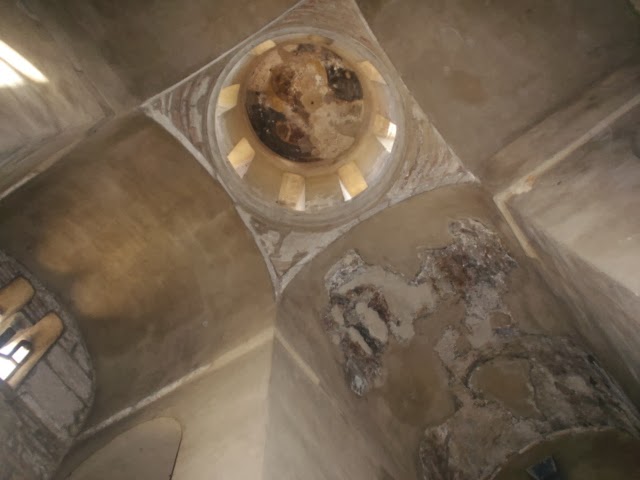
Inside its small dimensions serve to emphasize the height of the dome. Elegant ancient columns, braided at the top, lead the eye up and up into the narrow dome where the Pantocrator still resides. The other original wall paintings are gone. The plain marble templon looks new, but it is in the style of the era.


The Dome with the Pantocrator

These old churches all have stories attached to them. Because many of them were originally funeral chapels, stories of hauntings have proved especially popular. At Sotirakis they said a ghostly calf would appear at midnight and bawl three times  heralding the certain death of a parishioner At another Athenian church, now defunct, a snake with a cat’s head did the business.
Odysseus Androutsos (Οδυσσέας Ανδρούτσος) a Greek hero of the War of Independence is reputed to have been buried here after he was thrown off the Acropolis walls during the War of Independence.  He was unlucky enough to have been considered a traitor at the time. His reputation was later  restored, but his original tomb here is not marked. When his reputation was restored, his bones were dug up and re-interred in  Athens First cemetery, -after a 'proper' funeral attended by his wife and many dignitaries. See http://athensfirstcemeteryinenglish.blogspot.com/2016/09/odysseas-androutsos.html 

The attached chapel of Ag. Paraskevi (Ασκητήριων της Αγιας Παρασκυβής) may well have been an earlier cave sanctuary incorporated into Sotirakis during its construction. If you look at it from the outside, it is actually under a large rock. Ag. Paraskevi, as a healer of the blind, is a popular Greek saint.


 Chapel of Ag. Paraskevi

 Apparently she restored the sight of the Roman emperor Antonius Pius in the second century AD and he was grateful enough to stop his pogrom against Christians. His successor Marcus Aurelius was not as impressed and had her executed along with other members of the sect. She is depicted in icons holding one or two eyeballs so, unlike many female saints, she is quite recognizable. Tamata with eyes are placed by her icon.  Her feast day is July 26.